 Carlo DeLuca, Master plumber
As an Amazon Associate I earn from qualifying purchases. Some links are affiliate links.
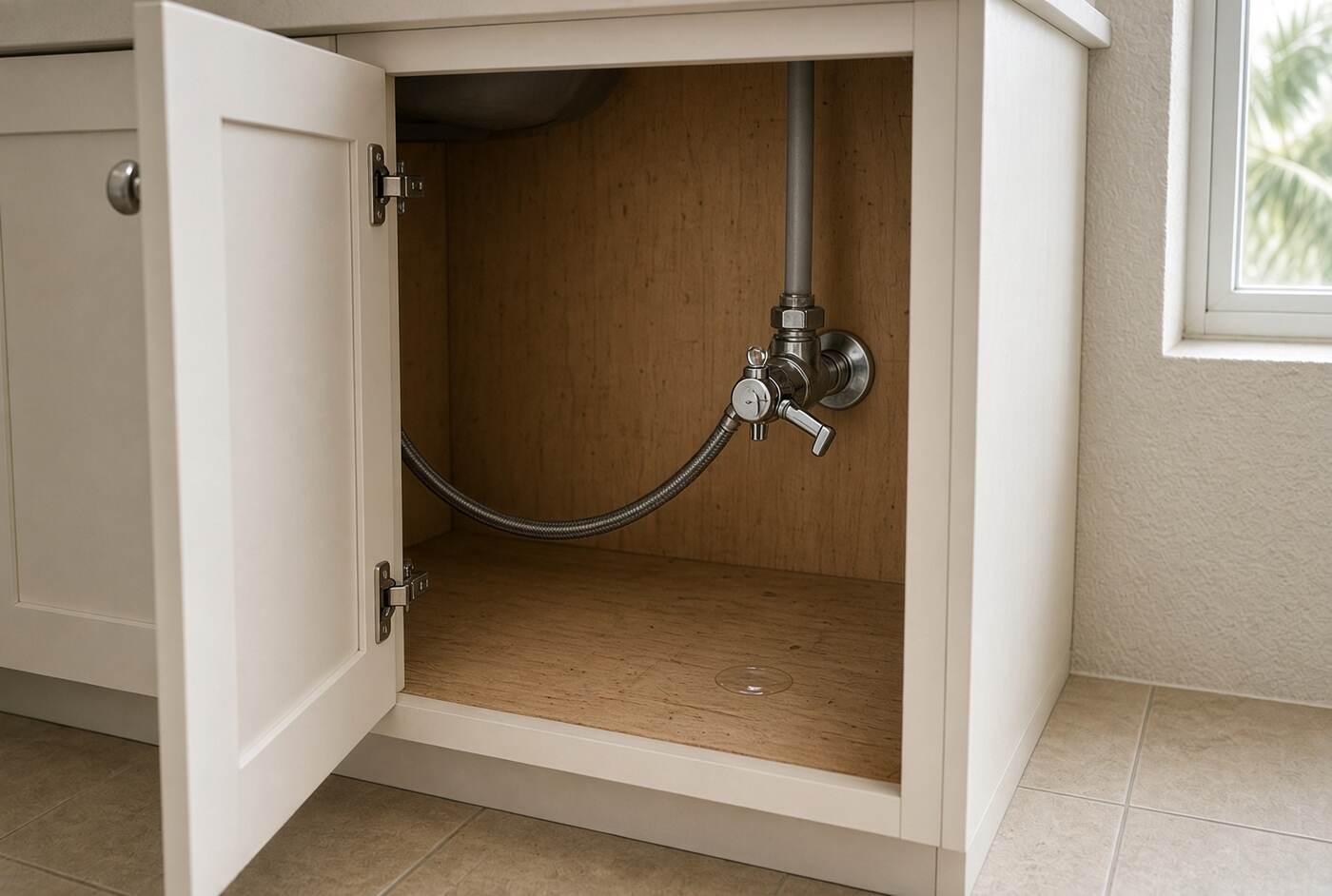
After work the guest bath still smelled like a closed room. The vanity door was cracked. The cabinet floor was dark in a circle that had not been there at breakfast. A chrome angle stop sat on the wall under the sink. The braided supply hose to the faucet was dry. The pop-up tail was dry. A bead had left the stem, just above the packing nut, and the circle on the plywood was the proof.
That is a coastal Florida guest bath on October 7. The house sat quiet for a week. Someone cracked the faucet this afternoon. The stop had been closed, then opened, and the stem wept on the way.
Reed’s note this morning is the aquarium stand that held the night, not this cabinet: the aquarium stand held the night. Name the stop before you blame a tank in the hall.
Why the stem weeps after a closed week
An angle stop is the little valve on the supply that feeds the faucet. The handle turns a stem. A packing nut holds a washer or an O-ring against that stem. Florida cabinets stay warm. A closed week lets the packing dry. The first open of the season rolls the stem and the seal does not follow. The hose stays dry because the leak is behind the hose, at the stem, not at the faucet nut.
Yesterday’s kitchen was a different fitting in a different cabinet: the ice-maker saddle wept under the sink. The sprayer hose that split is a pull-out, not a wall stop: the sprayer hose split under the sink. A tank that beads on the outside of a kids bath is sweat on the shell, not a stem: the kids bath tank wept on the tile. Wipe the packing nut. Wipe the hose ends. Wipe the tailpiece if you can see it. The wet one is the job.
A guest bath that stays shut is a room problem after the fitting is named. Reed’s closed-room note is the air, not the stop: the closed guest room stayed wet. The house guide for a shut guest bath is the same handoff: damp Florida guest room fix.
The circle sits under the stop, not under the hose loop. That is the difference between a packing weep and a nut that was never snug. A hose nut weeps at the braid. A stem weeps at the handle. Do not treat them as one joint.
Do not
Do not crank the packing nut until the handle will not turn. A crushed packing weeps worse, and a seized stem is a replacement, not a Tuesday fix.
Do not open the wall or cut the supply. This note is a look. If the stop is hissing, if the handle spins free, or if you cannot find the main shutoff, stop. A licensed plumber owns a pressurized line. I am not on the truck.
Do not soak the cabinet and call it a humidity job. A circle under the stem is a drip. The air in the guest bath is a different question, and it belongs to Reed after the water is named.
After-work check
Open the guest vanity before dinner. Palm light through the bath window is enough. Look at the stem, then the hose nuts, then the cabinet floor.
A dry hose and a wet circle under the stop is the tell. A wet hose nut is a different joint. A film on the whole floor with a dry stop is not this note. A stained toe-kick that was dry yesterday means the drip already walked into the hall.
October still finds stops that sat closed while the house was empty. A snowbird week does not pack a dried stem. The closed-house page is the air you come home to, not this valve: keep a closed Florida house dry.
If the hall tile is already dark at the vanity toe-kick, the drip left the cabinet. That is today’s job, not a setting on a phone. The puck note is placement after the fitting is named: five places a leak puck earns rent.
Run this
- Open the vanity. If water is standing, turn the local stop only if the handle still moves and you know it is the shutoff for that faucet. If it will not turn, leave it and call.
- Dry the stem, the packing nut, and the cabinet floor with a towel. Watch one minute. A new bead at the stem is the diagnosis.
- If the bead returns, do not tighten past a snug quarter turn on the packing nut. If it still weeps, the stop is done. Shut the water at a valve you trust, or call. Do not cut copper.
- If the floor already took the drip, pin the plywood before you close the door. Looks-dry is not dry.
A flood bag at the bath door buys the night if the circle is already walking the tile. It does not fix the stem. It holds the hall until a plumber can swap the stop.
If the cabinet floor already took the drip, pin it. A USA-made pin meter tells you whether the plywood is surface-wet or already soft under the veneer.
FloridaDamp is an Amazon associate — we earn from qualifying purchases. I still point at these two because a USA flood bag holds a vanity weep off the hall and a USA-made pin meter reads the cabinet floor the stop faced, not because anyone paid for a review.
Relative humidity (RH) in that guest bath is Reed’s beat after the fitting is named. House-wide context sits in the Florida humidity home guide. If the film already left the cabinet, the dry-out page is next: post-storm dry-out. The meter guide is the same job on the toe-kick: best moisture meter for drywall after a leak.
October still finds an angle stop that sat closed and marked the plywood. Name the stem. Leave the wall alone.
If it’s useful, it’s beautiful.