 Carlo DeLuca, Master plumber
As an Amazon Associate I earn from qualifying purchases. Some links are affiliate links.
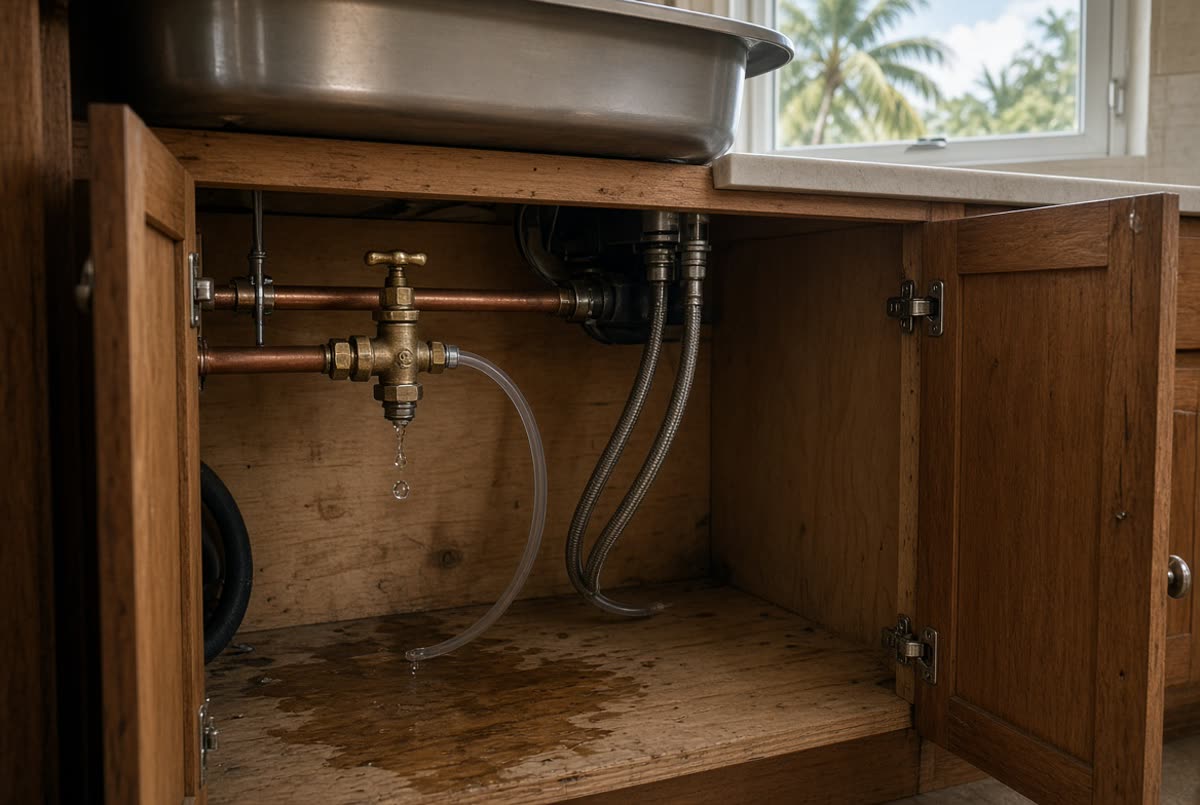
After work the kitchen window still had palms in it. The sink cabinet doors were cracked. The plywood floor was dark in a patch that had not been there at breakfast. A brass saddle sat on the copper cold line. A drop left the piercing point and hit the wood. A clear quarter-inch tube left the saddle and ran toward the back of the cabinet, then disappeared through the floor. The fridge, two steps away, had a dry kickplate.
That is a coastal Florida kitchen on October 6. The ice maker still dropped cubes. The leak was not at the fridge. It was at the old saddle that feeds the tube.
Reed’s note this morning is the hall thermostat calling the night fall, not a cabinet: the hall thermostat called it fall. The line that weeps at the kickplate is an older note: the fridge line wept into the kickplate. Name the saddle before you pull the fridge.
Why the cabinet floor is the tell
A saddle valve is a clamp that pierces the cold supply and feeds a small tube. Houses got them for ice makers. The seal is a ferrule against a hole someone made in the line years ago. Florida cabinets stay warm. The ferrule hardens. The screw weeps. The tube can look fine and the ice can still drop while the cabinet floor takes the drip.
The kickplate stays dry because the tube between the saddle and the fridge is intact. Yesterday’s sprayer failure was a different hose in this same cabinet: the sprayer hose split under the sink. The dishwasher hose that sat in a loop is a drain, not a supply: the dishwasher hose sat in the cabinet. Wipe the saddle. Wipe the sprayer nut. Wipe the dishwasher connection. The one that comes back is the job.
A whole-house filter housing on the garage slab is not this valve: the filter housing wept on the slab. Different room. Different fitting.
This is not a coil and not a pan. If the closet is dry and the cabinet floor is wet under the cold line, stay in the kitchen.
After-work check
Before you blame the ice maker. Before you pull the fridge and tip a pan of water onto the tile.
- Open both sink doors. Find the clamp on the copper or the brass cold line, not the braided hose to the faucet and not the sprayer coil.
- A drip at the piercing screw, or at the nut where the clear tube leaves, is the saddle. A drip at the sprayer nut is the October 3 hose. A wet loop on the dishwasher connection is the drain hose.
- Slide a dry paper towel under the saddle. Close the doors. Wait ten minutes. A new spot on the towel is a pattern, not a spill from the sink.
- Look at the fridge kickplate and the floor behind the fridge. Dry there, wet in the cabinet: the tube is carrying water and the saddle is losing it. Wet at the kickplate too: read the older fridge-line note before you call them the same leak.
- A dark toe-kick, or a stain that walked out of the cabinet onto the hardwood, is the path. Log it. Do not mop it into a rumor.
Do this the afternoon you notice the patch. The towel that spots again is the saddle.
Do not
- Do not tighten the piercing screw on a live saddle to “seat it.” That screw is what made the hole. Another turn can open it. Leave the cutter in the truck.
- Do not add a second saddle downstream because the first one weeps. Two holes in a cold line is not a repair.
- Do not pull the clear tube off to test the ice maker. An open tube on a pierced line is a fountain in a cabinet.
- Do not call it the sprayer because both live under the sink. The sprayer hose already had its note. This drip starts at the clamp.
- Do not size a machine for the kitchen because the cabinet smells closed. Kitchen air after the valve is named is Reed’s beat. The kitchen held the morning steam. I am naming a supply fitting.
Run this
- After work, confirm the drip starts at the saddle and the kickplate is dry, so you are not re-running the fridge-line note.
- A slow bead: towel, wait, write down whether it returns. If the saddle is running, not beading, shut the angle stop on that cold line and stop. Do not crack the piercing screw. A licensed plumber owns the replacement with a proper tee, not another clamp.
- If the film walked out of the cabinet onto the floor, bag the toe-kick side before it reaches the hall. Pin the cabinet floor and any dull toe-kick the drip faced. When the saddle is replaced, hand relative humidity (RH) in that kitchen to Reed. A quiet valve does not dry a cabinet that held the afternoon.
A USA flood bag at the toe-kick buys time if the film walks toward the hall. It does not reseat a saddle. It keeps the drip off the hardwood.
If the cabinet floor already took the drip, pin it. A USA-made pin meter tells you whether the plywood is surface-wet or already soft under the veneer. Looks-dry is not dry. Reed’s meter note is the handoff after the cabinet is honest: drywall can look dry and still be wet. The meter guide is the same job on the toe-kick: best moisture meter for drywall after a leak.
FloridaDamp is an Amazon associate — we earn from qualifying purchases. I still point at these two because a USA flood bag holds a toe-kick weep off the hall and a USA-made pin meter reads the cabinet floor the saddle faced, not because anyone paid for a review.
Relative humidity (RH) in that kitchen is Reed’s beat after the fitting is named. House-wide context sits in the Florida humidity home guide. If the film already left the cabinet, the dry-out page is next: post-storm dry-out.
October still finds an ice-maker saddle that drops cubes and marks the plywood. Name the clamp. Leave the piercing screw alone.
If it’s useful, it’s beautiful.