Quick answer
Size up from generic charts for Florida relative humidity (RH). Many homes start at 50–70 pints with continuous drain. The 35-pint Cube is a small-zone machine. There is no verified USA-built consumer 30–70 pint portable — AprilAire and Santa Fe are whole-home or crawl classes.
As an Amazon Associate I earn from qualifying purchases. Some links are affiliate links.
Pint ratings tell you how much moisture a dehumidifier can remove under a defined test condition. Florida homes routinely face higher outdoor relative humidity (RH), more infiltration, and longer rainy seasons than those lab baselines. Based on specs and common Florida use cases, size up from generic charts, then control with a humidistat so the unit cycles at your target relative humidity (RH).
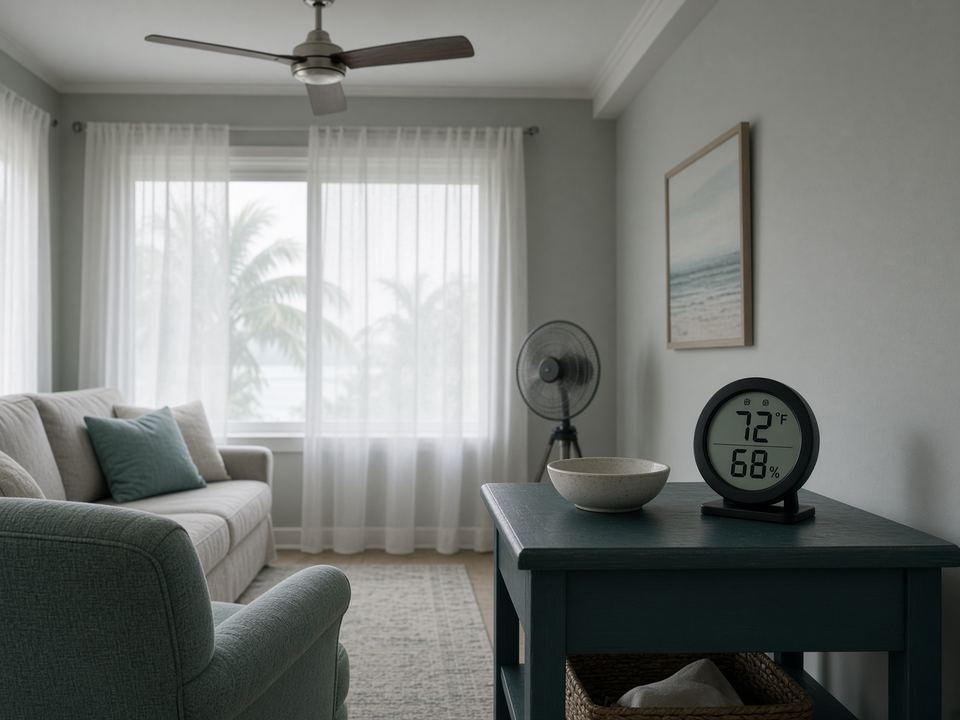
Indoor comfort target for most Florida living spaces: 45–55% relative humidity (RH), and keep sustained levels under 60%. Start from this chart, then refine with a hygrometer and the Florida humidity home guide. Do not start from a “covers 4,500 sq ft” banner — measure the zone and the AC first.
Florida pint chart (practical)
| Space / situation | Practical capacity class | Notes |
|---|---|---|
| Single closed room / large bath | 20–30 pints/day | Spot control only |
| Small condo / apartment (~under 800 sq ft) | 30–50 pints/day | Prefer continuous drain |
| Mid home / open plan (~1,000–1,800 sq ft) | 50–70 pints/day | Florida baseline for many households |
| Large / leaky / older home (~2,000+ sq ft) | 70–90+ pints/day or multiple units | Or evaluate whole-home HVAC options |
| Attached garage (hot) | 50–70+ pints/day | Needs high-temp operation—see garage guide |
| Coastal home (salt air load) | Often 50–70+ with corrosion-minded features | See coastal guide |
| Crawl space | Purpose-built crawl unit, not a bedroom portable | See portable vs crawl space |
| Florida room / enclosed porch | Size only after the room is closed to outdoor air | Leaky jalousies make any size look too small—see Florida room guide |
Reading tip: Marketing “coverage up to X sq ft” assumes milder moisture. In Florida rainy season, treat those claims as optimistic.
October note (2026): The summer rainy season usually tapers through October across much of the peninsula, but the Atlantic hurricane season runs through November 30. Don’t downsize or park a unit for “cooler weather” until a week of hygrometer logs holds 45–55% without it, and keep continuous drain connected through fall.
How to choose capacity in four steps
- Measure the zone you actually need to dry (whole home vs one wing vs garage).
- Pick the chart row, then bias upward for Florida infiltration, frequent door openings, or weak AC dehumidification.
- Require continuous drain for anything running daily.
- Verify with a hygrometer for 7 days at ~50% setpoint before buying a second unit.
AC still matters
A correctly running AC removes moisture while cooling. A dehumidifier handles humidity when the AC short-cycles or during mild, rainy weather. Read AC vs dehumidifier in Florida before overspending on portable capacity.
Want USA-built? Whole-home:
AprilAire E100C or
E080. Garage/crawl:
Santa Fe Compact70. Storm dry-out:
Dri-Eaz Revolution. There is no verified USA consumer 30–70 pint portable.
Product picks by size class
Educational slots based on specs and common Florida use cases.
Good — 30–40 pint class (small condo / bedroom zone)
Midea Cube 35-pint class (overseas-made — no USA badge). No verified USA consumer 30–50 pint portable exists; listed for size only. The Amazon Buy box on this model is not available, so this is a value search, not a featured buy.
Midea Cube 35-pint dehumidifier
Better — 70 pint class (most Florida households / open plan)
Keystone 70-pint with pump (overseas-made — no USA badge). No verified USA consumer 30–70 pint portable. The Amazon Buy box on this model is not available, so this is a value search, not a featured buy.
Keystone 70-pint dehumidifier with pump
Best — AprilAire E100C 100-pint (USA-built whole-home / large)
Add-on — USA-made hygrometer (living + bedroom)
SensorPush HT.w. Amazon title “USA made”; sensorpush.com: HT.w “designed, supported, and now made in the USA” (not the China-made HT1). Made in America badge-eligible. Buy two for the living room and a bedroom. Replaces the ThermoPro pack on this page.
Add-on — BlueMaestro Disc Maxi (dew-point logger)
Same USA-made dew-point logger. Made in America badge-eligible.
Add-on — Assembled USA condensate pump (PumpSpy CP-120)
Assembled in Kalamazoo, MI from domestic and imported parts (Amazon bullet + pumpspy.com). Badge-eligible.
Common sizing mistakes
- Buying a tiny unit for a whole open-concept Florida living area.
- Ignoring continuous drain, then abandoning the unit after a week of emptying.
- Placing the only hygrometer next to the AC vent or dehumidifier exhaust.
- Sizing for a Florida room or porch that is still open to outdoor air.
- Expecting a portable to fix a wet crawl space—use a crawl-rated system instead.
- Skipping filter cleaning until airflow collapses.
Related cluster pages
- Condo size + continuous drain
- Garage dehumidifier
- Coastal Florida dehumidifier
- Florida room / enclosed porch
- Damp Florida guest room fix
- Damp Florida laundry room fix
- Leaving-town checklist
DOE/AHAM-style ratings vs Florida reality
Pint ratings are measured under defined laboratory temperature and humidity conditions. Florida living rooms, garages, and lanai-adjacent spaces often differ—hotter, wetter, and leakier. That is why this site treats manufacturer square-footage banners as optimistic and pushes continuous drain plus hygrometer verification.
If two listings both say “50 pint,” compare:
- Continuous drain included vs optional
- Auto-restart after power loss
- Stated operating temperature range
- Built-in pump vs gravity-only
- Filter access and noise claims for bedroom use
Whole-home vs portable capacity
Portable pint classes on this page are for spot and zone control. Whole-home HVAC-integrated dehumidifiers are a different product category (often higher daily removal when professionally sized). If portables cannot hold relative humidity (RH) across a large house, ask an HVAC contractor about ducted options after confirming AC airflow and drain health (AC vs dehumidifier).
Garage and coastal adjustments
Garages need high-ambient awareness—see garage. Coastal homes should also scan listings for coated-coil or corrosion-resistant language—see coastal. Neither adjustment replaces a hygrometer; both change which capacity class and features you prioritize.
Bottom line
For many Florida homes, the 50 pint continuous-drain class is the practical starting point; go 70+ for large or leaky spaces, and 30–40 for tight condo zones. Confirm with hygrometers, not guesswork.