 Carlo DeLuca, Master plumber
As an Amazon Associate I earn from qualifying purchases. Some links are affiliate links.
People buy one leak sensor. They put it “near the water heater” on a shelf. Then the washing-machine hose lets go at 2 a.m. and the puck has a lovely view of nothing.
Water runs downhill. The sensor belongs in the downhill. Walk a Florida house once and you will find five downhill places that earn the slot. The future is now: the phone can take the night shift. You still have to put the puck on the floor.
This is placement, not a license to open a pressurized supply. Do not cut copper. Do not “just tighten it” on a hissing valve if you do not know the shutoff. Look. Place. Test.
1. Water heater pan
Garage heaters in Florida live in a climate the nameplate never wanted. The tank weeps. The anode rod dies on a schedule nobody wrote down. A metal pan with no drain is a bucket.
Puck in the pan, pads down. If the pan already holds rust flakes and a tide line, you have a leak with a history. Call a licensed plumber for the tank. The puck is how you catch the next one while you are in the Keys.
2. Washing machine hoses
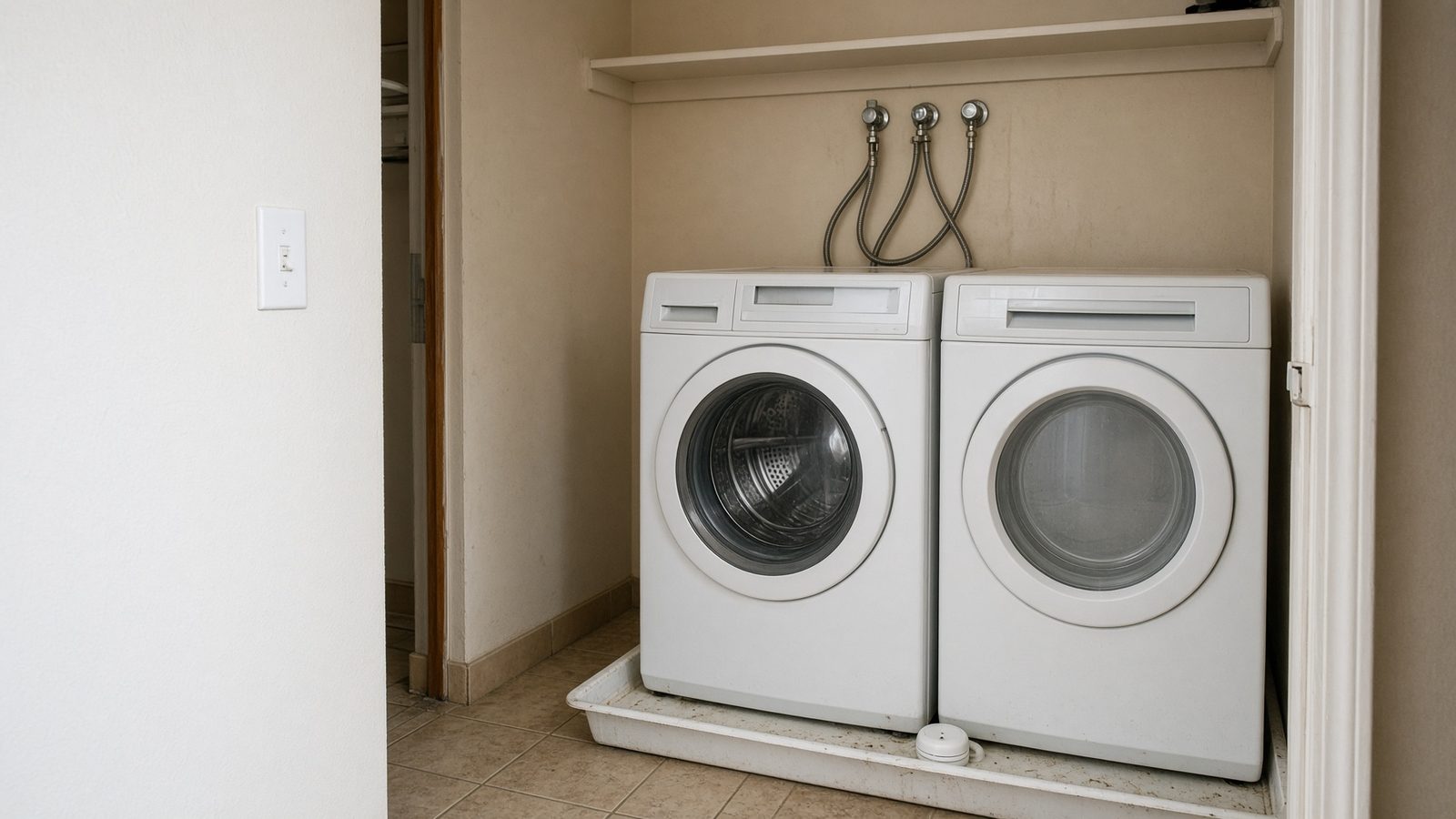
Rubber supply hoses fail. They fail on weekends. They fail when the machine is mid-cycle and you are not home. Steel-braided hoses are cheaper than a floor. A puck on the pan or the slab under the box is cheaper than both.
If you can see cracked rubber, replace the hoses. That is a shutoff-and-swap most people can do if they know where the valves are. If you cannot find the shutoff, stop. Plumber.
3. Fridge line
Thin tubing. A saddle valve from 2009. A dark kickplate. The leak is a hiss into particle board for a month. One puck behind or under the fridge, wherever water would pool, not on top of the ice maker.
If the floor is already swollen, pin the drywall or base: moisture meter after a leak. Then the puck is for next time.
4. Toilets and vanities that already stained
A supply that wept once will weep on a long weekend. Puck on the floor behind the bowl, or in the vanity base if the trap has a reputation. You are not repairing the wax ring from a blog. You are getting a text so you can shut the valve.
5. Air-handler closet
Condensate is not a “supply leak,” but the closet is still the room that floods a hallway. Overflow pan gets a puck. I wrote the why separately: the overflow pan should text you. If you only buy one sensor and you have a closet air handler, start there.
How to test without flooding the house
Wet fingertip on the pads. Phone should buzz within seconds. If it does not, the gateway is on the wrong band, the puck is unpaired, or you have a dead battery. Fix that before you leave town.
Walk to the driveway. Trigger it again. Attic and garage pucks lie if the gateway never hears them.
Power outages: the puck may keep a local siren. The push to the phone needs the gateway and the Wi-Fi. After a storm, check the app before you trust the vacation setup. Reed covers empty-house relative humidity (RH): keep a closed Florida house dry. A leak puck is the puddle half of that job.
What not to do
- Do not hide the puck in a cabinet “for aesthetics.” Water will not climb to visit it.
- Do not skip the water heater because “it’s in the garage.” Garage drywall and the car both care.
- Do not open a pressurized line to “test the sensor.” Wet finger. That is the test.
- Do not treat a text as a repair. Shut the valve if you know which one. Then a licensed plumber if it is supply.
Run this
- Five minutes, flashlight, five downhill spots.
- Pucks in the pans and under the hoses. Gateway on 2.4 GHz. Wet-finger test from the driveway.
- If any pan is already wet, that is today’s job, not a notification setting. Your phone knows before the ceiling.
Carlo DeLuca is a third-generation master plumber. Family trade from Long Island, writing from coastal Florida. This note is not a service call. If a supply is hissing and you cannot find the shutoff, get a licensed plumber on site.
If it’s useful, it’s beautiful.