Quick answer
Measure the rooms the machine will actually see, not the listing square footage. Log relative humidity (RH) for a week. Read AC tons off the outdoor data plate. Then open the pint chart and bias up for Florida. A 35-pint cube is not a 1,800 sq ft house.
As an Amazon Associate I earn from qualifying purchases. Some links are affiliate links.
Do not buy pints from a banner that says “covers 4,500 sq ft.” That number was written for a milder moisture load than a Florida rainy season. Measure the zone. Read the AC. Then open the pint chart.
This page is the tape-measure step. The hygrometer guide is the relative humidity (RH) step. Together they are Measure first. Based on specs and common Florida use cases — not a Manual J and not a lab.
Indoor target for living space stays 45–55% relative humidity (RH). Sustained above 60% is the cue to act.
1. Walk the zone, not the listing
Tax-roll and Zillow square footage include garage, lanai, and sometimes a bonus room the AC never sees. A dehumidifier only dries the air that can reach it.
Measure conditioned rooms that share air:
- Sketch the floor. Split L-shapes into rectangles.
- Length × width for each rectangle. Add them. That is the zone in sq ft.
- Note ceiling height. An 8 ft box and a 12 ft volume are not the same job.
- Closed doors are a different zone. A shut bedroom is not the great room. The garage is never the house.
| What you include | What you leave out unless it is the job |
|---|---|
| Open living, kitchen, halls | Garage, carport |
| Bedrooms that stay open to the AC | Screened lanai, patio |
| Interior closets on that floor | Unconditioned bonus / attic |
Volume is sq ft × average ceiling height. You will not find a honest pint chart in cubic feet on a consumer box. You use volume to stop treating a two-story volume like a 1,200 sq ft ranch.
2. Worked Florida examples
Closed bedroom, 14 × 16, 8 ft ceiling. 224 sq ft. That is a small-zone machine if the door stays shut — often the 30–50 pint class, not a 70-pint tower in the hallway.
Open great room + kitchen, 20 × 32, 10 ft tray. 640 sq ft of floor, taller air. It still shares air with the rest of a 1,600 sq ft house if the plan is open. Size the open plan, not the one rectangle.
1,800 sq ft single-story, 8 ft, attached two-car garage. Conditioned zone ≈ 1,800. Garage is a second job: hot, unconditioned, own high-temp machine. Do not drag the living-room portable into the bay and call it done.
Condo, 900 sq ft, no floor drain. Measure the unit, not the building. Then read no floor drain for the pump, not a bigger pint number.
Log relative humidity (RH) in the zone you measured for seven days. Morning and evening. Interior wall, not on the supply vent and not on the dehumidifier exhaust. Guide: hygrometer.
3. Translate square footage into a pint class
AHAM-style charts for “moderately damp” rooms undershoot Florida infiltration. This site biases up one class from those banners, then verifies with the hygrometer.
| Conditioned zone you walked | First pint class (living space) | Notes |
|---|---|---|
| Under ~800 sq ft, doors closed | 30–50 pints/day | 35-pint cube is this row, not the whole house |
| ~1,000–1,800 sq ft open plan | 50–70 pints/day | Florida baseline for many households |
| ~2,000 sq ft+ or leaky / older | 70–90+ or whole-home | Or more than one zone machine |
| Attached garage (unconditioned) | 50–70+ high-temp | Separate from the house number |
Full table, drain, and product slots: Best dehumidifier size for Florida humidity.
After a storm, leftover wet assemblies are a different load than square footage. That is how big after a storm, not a bigger Amazon banner.
4. Read the AC you already have
A dehumidifier is the backstop. The AC is still the main coil in the house. If it is the wrong size, you will fight humidity all summer.
One ton = 12,000 BTU/h of cooling. Residential outdoor units are commonly 1.5 to 5 tons.
How to read the data plate (outdoor cabinet, no tools, do not open the panel):
- Find the model number sticker.
- Many U.S. brand strings embed the BTU: 24 ≈ 2 ton, 30 ≈ 2.5, 36 ≈ 3, 42 ≈ 3.5, 48 ≈ 4, 60 ≈ 5.
- Write down tons and the conditioned sq ft you walked. Divide: sq ft ÷ tons.
Example: 1,800 sq ft ÷ 4 ton = 450 sq ft per ton. Example: 1,800 ÷ 3 ton = 600 sq ft per ton.
A rough Florida look used by contractors as a starting point — not a permit — is about 500–600 sq ft of conditioned space per ton. National “600–700 sq ft per ton” charts skip the latent load here. Latent load is the moisture. In Florida it is a large share of the cooling job, not a footnote.
This is not a Manual J. Manual J (ACCA) is the load calculation a licensed contractor runs from insulation, glass, orientation, ducts, and infiltration. Two 1,800 sq ft houses can need different tons. FloridaDamp does not sell that calc and does not replace it.
5. Why oversized AC makes a clammy house
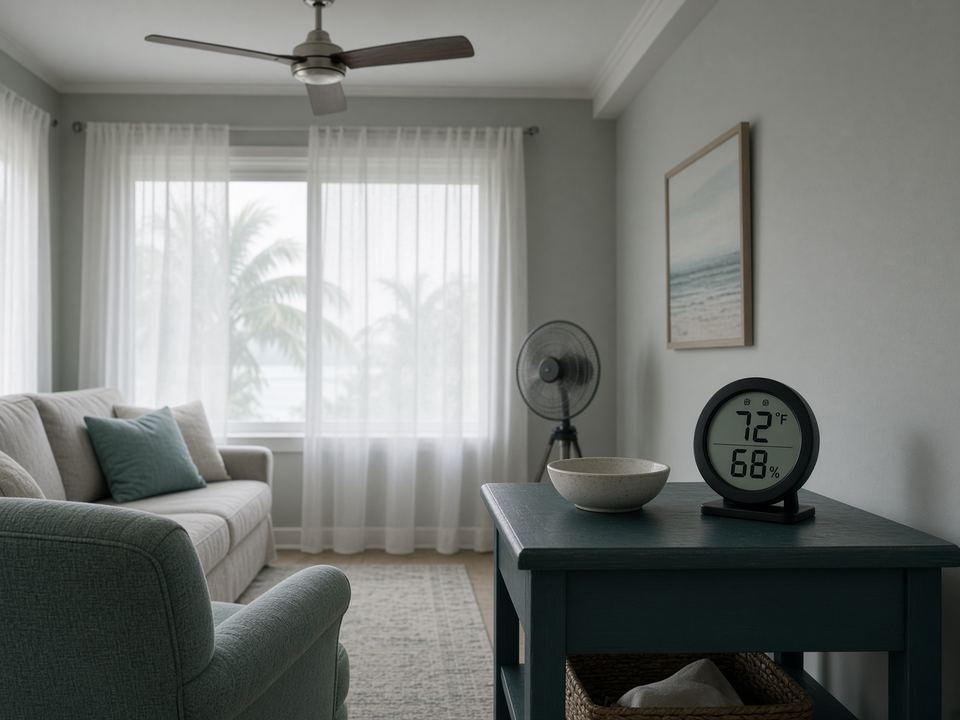
The coil wrings water only while the compressor runs. An oversized system hits the thermostat fast, shuts off, and leaves vapor in the air. The house reads 72°F and 62% relative humidity (RH). That is short-cycling. It is a humidity problem, not a “buy a colder thermostat” problem.
Undersized systems run long. They often dehumidify better and still miss temperature on the worst afternoon. Neither extreme is the goal. Right-sized, longer, quieter run time is.
Before you add pints:
- Fan AUTO, not ON. ON re-evaporates water off a wet coil.
- Filter actually replaced.
- If the air handler is sitting in water or the closet smells like a drain, stop. That is a plumbing note — Carlo DeLuca — not a bigger dehumidifier.
Then read AC vs dehumidifier in Florida. AC for temperature. Dehumidifier for the days the compressor barely runs.
6. Put the two numbers next to each other
| You measured | What it usually means here |
|---|---|
| relative humidity (RH) 45–55%, AC runs in long cycles | Hold. Filter and drain. Optional portable for shoulder rain. |
| House is 72°F, relative humidity (RH) stuck above 60%, AC short-cycles | Suspect oversized tons vs the sq ft you walked. HVAC review. Dehumidifier will help; it will not fix a 5-ton box on a 1,400 sq ft ranch. |
| relative humidity (RH) high only in one closed room | Small-zone pint class for that room. Do not upsize the whole house. |
| relative humidity (RH) high in the garage only | Garage-class machine. The house AC does not see that bay. |
| Mild rainy week, AC barely runs, relative humidity (RH) climbs | This is the dehumidifier’s job. Size from the zone sq ft and the pint chart. |
Want USA-built after you measure? Whole-home class:
AprilAire E080 or
E100C. Garage/crawl:
Santa Fe Compact70. There is no verified USA-built consumer 30–70 pint portable.
Product picks (measure, then buy)
Educational slots from specs and common Florida use cases.
Do this first — digital hygrometer 2-pack
Living zone and bedroom. Log a week in the square footage you walked.
Better — Tempo Disc Maxi (USA-made logger)
When you leave town or you want a week of numbers, not two glances.
Then size — 70 pint class (most open-plan Florida zones)
Keystone 70-pint with pump (overseas-made — no USA badge). Use it after the sq ft and relative humidity (RH) say 50–70, not because the box says 4,500 sq ft.
Whole-home — AprilAire E100C (USA-built)
When the walk says 2,000 sq ft+ and a portable cannot hold 55%.
Related pages
- Hygrometer — relative humidity (RH) before pints
- Pint chart — capacity class after you measure
- AC vs dehumidifier — what each machine is for
- Florida humidity home guide
- Wet drywall — air relative humidity (RH) is not a wet wall
Bottom line
Walk the conditioned zone. Write the square footage. Read the tons on the outdoor sticker. Log relative humidity (RH) for a week. Then buy a pint class from the Florida chart — up from generic square-footage banners — with continuous drain. A 35-pint cube is a small zone. A 4-ton condenser on a small ranch is why the house feels cold and wet.