 Carlo DeLuca, Master plumber
As an Amazon Associate I earn from qualifying purchases. Some links are affiliate links.
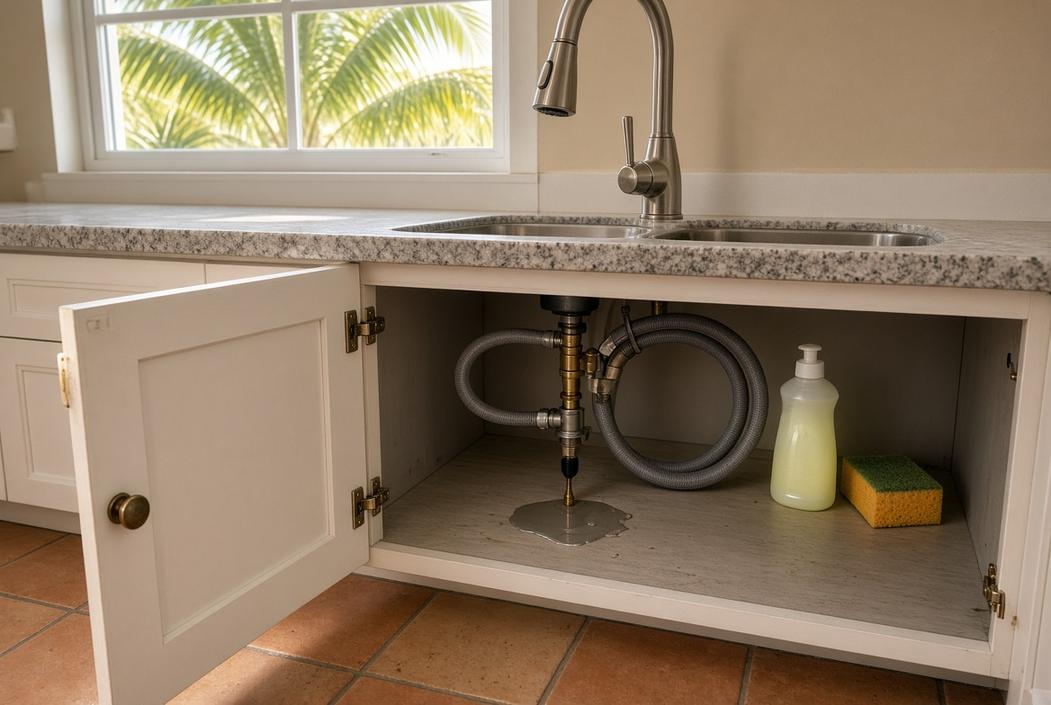
The soap bottle was dry. The cabinet floor was not. After a Saturday cook the pull-down faucet sat back in the spout, palms in the window, and a gray coil under the sink had a wet split at the brass coupling. The dishwasher line on the side wall of the cabinet was dry. The wet patch belonged to the sprayer hose.
That is a coastal Florida kitchen on October 3. Guests ran the sprayer all afternoon. The hose comes out, kinks at the weight, and goes back in warm. The dishwasher hose is the usual thing people blame, because it is the wet tube they already know.
Reed’s kitchen note is the steam in that room, not this coil: the kitchen held the morning steam. Today’s stair note is a different assembly, milder air on a landing, not a hose in a base: the stair landing held the milder night. Name the coil before you name the machine.
Why the coil splits
A pull-down sprayer is a supply hose on a weight. It lives in the cabinet. It flexes every time someone rinses a pan. Florida chlorine and cabinet heat age the braid. The weight rides the same bend. October Saturdays finish the job.
Three things show up the same evening. The hose is cracked at the crimp where it meets the brass. The coil is pinched under a stored pot and the split is on the flat. The coupling at the spout end weeps, and the drip runs down the hose, so the wet spot is not where the leak starts. A hairline looks small. On a live hose it does not stay small.
This is not the dishwasher tube that sat in the cabinet: the dishwasher hose sat in the cabinet. That hose runs to the machine, usually along the side wall. This coil hangs off the faucet. It is not the fridge line in the kickplate: the fridge line wept into the kickplate. It is not the filter housing on the garage slab: the filter housing wept on the slab. Do not walk the air handler first: the closet was dripping.
Read the drip, then stop
Open the door. Dry the floor with a towel. Watch one drop. If it leaves the gray coil or the brass crimp, you have a name. If it leaves the dishwasher connection on the side wall, you are in that note, not this one. If the shell is beaded and the hose is dry, you may be looking at sweat on a cold supply in a steamy kitchen. Wipe the tubes. Wait. A split comes back at the crack. Sweat comes back on the metal.
Do not cut the coil while the stops are open. That hose is on the supply. This note is not a dispatch. Do not pull the sprayer out to “just see” and leave it hanging over a live split. Do not tape the braid and call it fixed. Do not store a roasting pan on the coil. Do not blame the dishwasher because both tubes share a cabinet.
If you cannot see the stops under the sink, stop. Get a licensed plumber on site.
After-work check
After work, before the pans go back in the base, look at the cabinet floor under the coil. A dry dishwasher hose and a wet gray coil is the tell. A stained toe-kick that was dry yesterday means the drip already walked. Reed’s closed-house guide is the air you come home to, not this hose: keep a closed Florida house dry.
Morning check is the same door. Before coffee, look under the coil. A new ring means the split is still live. Do not start the sprayer to “see if it still works.”
Hold the floor, then hand off the air
A USA flood bag at the toe-kick buys time after the stops are shut. It does not fix the coil. It keeps the weep off the cabinet bottom and the tile.
If the toe-kick already took water, pin it. A USA-made pin meter tells you whether the stain is surface or already in the paper. Looks-dry is not dry. Reed’s meter note is the handoff after the cabinet is honest: drywall can look dry and still be wet. The meter guide is the same job: best moisture meter for drywall after a leak.
FloridaDamp is an Amazon associate — we earn from qualifying purchases. I still point at these two because a USA flood bag holds a cabinet weep off the toe-kick and a USA-made pin meter reads the kick after the drip, not because anyone paid for a review.
Relative humidity (RH) in the kitchen is Reed’s beat after the coil is dry. Steam from the cook is a different wet: the kitchen held the morning steam. House-wide context sits in the Florida humidity home guide. I am naming a hose.
Run this
- After work, open the sink base. Confirm the drip starts at the gray coil or the brass crimp. Confirm the dishwasher hose on the side wall is dry so you are not chasing that tube.
- If you can see the stops, shut them and watch the coil. If the drip stops, the sprayer hose was the source. If you cannot see the stops, stop. Do not cut the hose. Get a licensed plumber.
- Bag the toe-kick so the wet floor does not wick the cabinet. Pin any stained kick. When the coil stays dry, log relative humidity (RH) in the kitchen for a week and hand that log to Reed’s kitchen note. A dry hose does not dry a kitchen that held the steam.
October Saturdays run the sprayer hard. The dishwasher hose on the wall is a bystander until it is wet. Name the coil. Shut the stops. Leave the knife in the drawer.
If it’s useful, it’s beautiful.