As an Amazon Associate I earn from qualifying purchases. Some links are affiliate links.
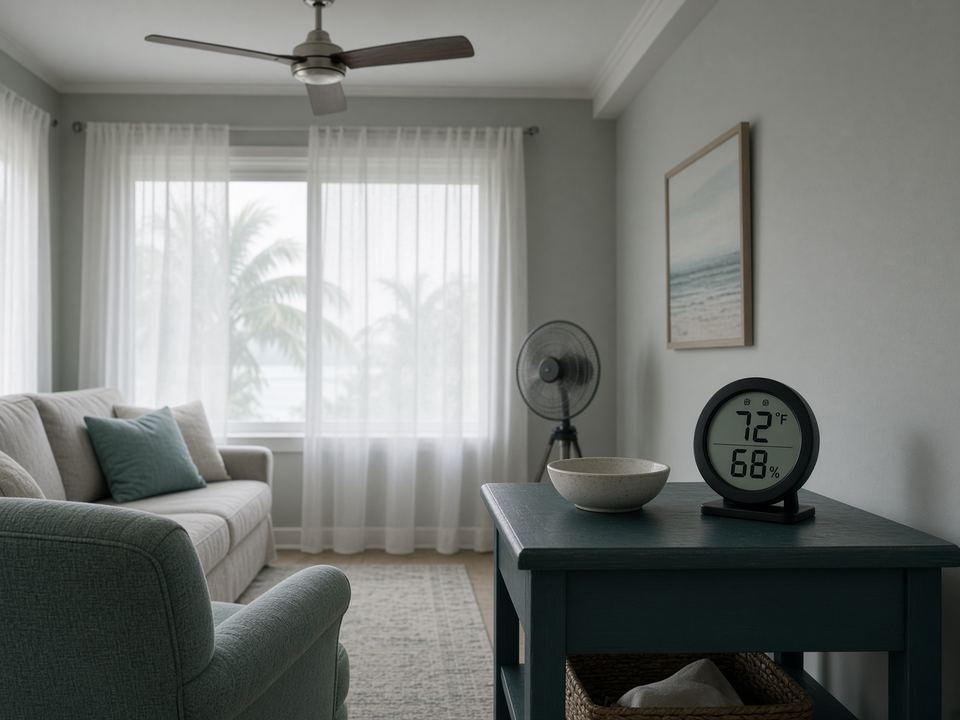
You cannot size or trust a dehumidifier without knowing relative humidity. Thermostat “feels sticky” is not data. Based on specs and common Florida use cases, every humidity project should start with at least one calibrated-style digital hygrometer in the main living zone and ideally a second in a bedroom or closet.
FloridaDamp’s practical indoor target remains 45–55% relative humidity (RH), with sustained levels above 60% as a cue to act (AC check, dehumidifier, infiltration). Context: Florida humidity home guide and AC vs dehumidifier.
What to look for
| Feature | Why it matters |
|---|---|
| Digital relative humidity (RH) + temperature | Fast room checks |
| ±2–3% relative humidity (RH) accuracy class (as listed) | Good enough for home decisions |
| Min/max memory | Catch overnight spikes |
| Remote / Wi-Fi / Bluetooth options | Empty-house and multi-room monitoring |
| Easy placement | Away from vents, windows, and dehumidifier exhaust |
Avoid trusting a single reading taken next to a supply vent or in direct sun on a slider.
Placement map for Florida homes
- Main living room — primary decision meter.
- Master bedroom — overnight comfort and closet moisture.
- Garage or laundry — if those zones drive complaints (garage guide).
- Crawl access — only with sensors rated for that environment; pair with portable vs crawl.
Log morning and evening values for a week before upsizing equipment from the pint chart. Square footage of the zone belongs in that same notebook: measure sq ft and AC size.
Want USA-built hygrometers? Prefer
Tempo Disc Maxi or
SensorPush HT.w (USA-made). ThermoPro multipacks below are overseas-made — no Made in America badge.
Product picks
Educational recommendations based on specs and common Florida use cases—not invented star ratings.
Good — Simple digital thermo-hygrometer
Affordable first meter for one room.
Better — 2- or 3-pack for multi-room mapping
Best value for Florida homes that need living + bedroom + closet coverage.
Best — Tempo Disc Maxi (USA-made logger)
Ideal when you leave town or watch a second home — see keep a closed house dry.
Add-on — Sensor calibration salt test kit (optional)
Useful if you want a cheap confidence check against a known relative humidity (RH) reference method described by the kit maker.
Pairing product — Continuous-drain dehumidifier starter
Once relative humidity (RH) is confirmed high, size a unit from the chart and buy a drain-ready model:
How to use readings (no guesswork)
- Consistently 45–55% with AC on: maintain filters; optional dehumidifier for shoulder seasons.
- Often 55–60%: improve AC dehumidification habits (fan AUTO) and consider a portable.
- Often above 60%: treat as actionable—equipment, sealing, or professional HVAC review.
- After leaks/storms: air relative humidity (RH) is not the same as wet drywall—use a moisture meter.
Related pages
Calibration confidence without lab gear
Many inexpensive meters are consistent even if slightly offset. What matters for home decisions is trend and zone-to-zone comparison. If three meters in one room disagree wildly, replace the outliers. Optional salt-test kits exist for hobbyist checks; follow the kit maker’s method exactly.
Smart vs dumb meters
Dumb digital meters are fine for daily glances. Smart meters earn their keep for travel, second homes, and alerting when relative humidity (RH) crosses 60% while you are away (leaving-town checklist). Either way, place sensors thoughtfully—HVAC supply blasts and dehumidifier exhaust skew readings.
Tie readings to purchases
- High relative humidity (RH) in one bedroom only → smaller quiet unit (condo).
- High relative humidity (RH) whole home → 50–70 pint class (size chart).
- High relative humidity (RH) only in garage → garage-capable unit (garage).
- High relative humidity (RH) after storms with wet walls → add a moisture meter (drywall meter).
Battery and display tips
Replace batteries on a fixed calendar (start of rainy season and before travel). Prefer displays you can read at a glance from across the room. If using app sensors, confirm notifications work on cellular when home Wi-Fi drops during storms.
Bottom line
Buy a multi-pack of digital hygrometers (Better) or a remote sensor (Best) before you overspend on capacity. Measure for a week, then choose equipment from FloridaDamp’s sizing and product pages.