 Carlo DeLuca, Master plumber
As an Amazon Associate I earn from qualifying purchases. Some links are affiliate links.
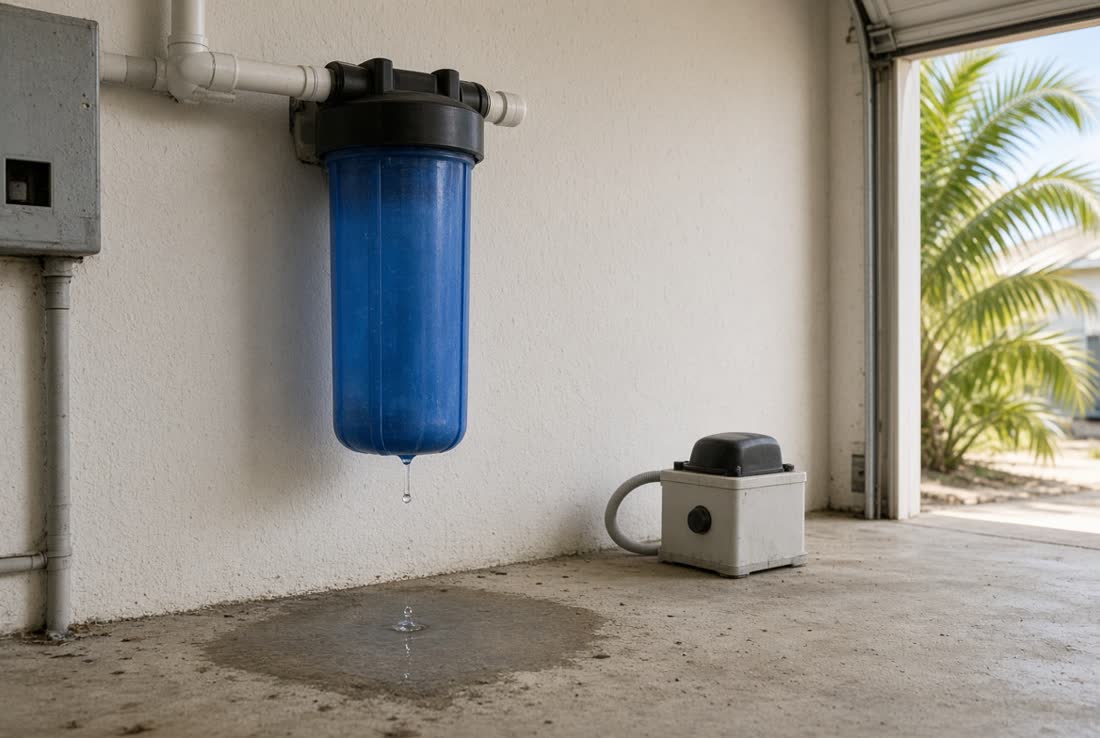
The pump lid was dry. The slab under the blue canister was not. After work on an October afternoon the garage door was up, palms in the light, and a drip left the seam where the sump meets the cap. The condensate pump sat a foot away with a clean lid and a dry hose. The wet circle belonged to the filter housing.
That is a coastal Florida garage on October 2. The coil is still wringing. Houses swap cartridges this month. The swap is the usual reason the seam weeps. The pump is the usual thing people blame, because it is the wet machine they already know.
Reed’s garage note is the air in that room, not this seam: the garage is its own climate. Today’s lanai note is a different assembly, cushions left out, not a canister on a wall: the lanai cushions sat out all night. Name the drip before you name the machine.
Why the seam weeps after a swap
A whole-house housing sits on the cold line, usually in the garage. The sump screws into a cap. A rubber ring in a groove is the seal. Garage heat ages that ring. Chlorine and scale finish the job. October is when the cartridge comes out. The ring comes with it, or it does not.
Three things show up the same afternoon. The old ring is still in the groove and the new one sits on top of it. The new ring is pinched out of the groove. The ring went back in dry and twisted. Any of those weeps at the seam. A hairline at the cap looks small. On a live line it does not stay small.
This is not the pan that had nowhere to go: the heater pan had nowhere to go. It is not sweat on a cold tank: the kids-bath tank wept on the tile. Sweat beads on the shell. A housing weep starts at the seam. It is not the pump that never left its reservoir: the garage pump sat in its own water. That lid was wet. This lid is dry. Do not walk the air handler first: the closet was dripping.
Read the drip, then stop
Stand at the housing. Watch one drop. If it leaves the seam, you have a name. If it leaves the pump lid or the pump hose, you are in the pump note, not this one. If the canister shell is beaded and the seam is dry, you may be looking at sweat on a cold sump in wet garage air. Wipe the shell. Wait. A seam weep comes back at the joint. Sweat comes back on the plastic.
Do not spin the sump off while the inlet is open. That housing is on the supply. This note is not a dispatch. Do not crack a live sump to “just look.” The red button on the cap is a relief, not a license to open the bowl. Do not leave the weep overnight because the circle looks small. Garage slab finds the drywall at the stem wall. Do not tape the seam and call it fixed.
If you cannot see a bypass, stop. Get a licensed plumber on site.
After-work check
After work, before the garage door comes down, look at the slab under the housing. October cartridge swaps fail the same day. A dry pump lid and a wet seam is the tell. A stained baseboard that was dry yesterday means the drip already walked. A closed snowbird week does not seal a pinched ring. Reed’s closed-house guide is the air you come home to, not this canister: keep a closed Florida house dry.
Hold the slab, then hand off the air
A USA flood bag at the wall buys time after the bypass is shut. It does not fix the ring. It keeps the weep off the stem-wall drywall.
If the baseboard already took water, pin it. A USA-made pin meter tells you whether the stain is surface or already in the paper. Looks-dry is not dry. Reed’s meter note is the handoff after the slab is honest: drywall can look dry and still be wet. The meter guide is the same job: best moisture meter for drywall after a leak.
FloridaDamp is an Amazon associate — we earn from qualifying purchases. I still point at these two because a USA flood bag holds a slab weep off the wall and a USA-made pin meter reads the baseboard after the drip, not because anyone paid for a review.
Relative humidity (RH) in the garage is Reed’s beat after the seam is dry. The room over that slab can hold the wet air: the bonus room held garage air. House-wide context sits in the Florida humidity home guide. I am naming a seam.
Run this
- After work, stand at the housing with the garage door up. Confirm the drip starts at the cap seam. Confirm the pump lid and the pump hose are dry so you are not chasing the reservoir that never left.
- If you can see a bypass, shut it and watch the seam. If the drip stops, the housing was the source. If you cannot see a bypass, stop. Do not spin the sump. Get a licensed plumber.
- Bag the wall base so the wet slab does not wick the drywall. Pin any stained baseboard. When the seam stays dry, log relative humidity (RH) in the garage for a week and hand that log to Reed’s garage note: the garage is its own climate. A dry seam does not dry a shut garage.
October is cartridge month. The pump on the slab is a bystander until its lid is wet. Name the seam. Shut the bypass. Leave the wrench in the drawer.
If it’s useful, it’s beautiful.