 Carlo DeLuca, Master plumber
As an Amazon Associate I earn from qualifying purchases. Some links are affiliate links.
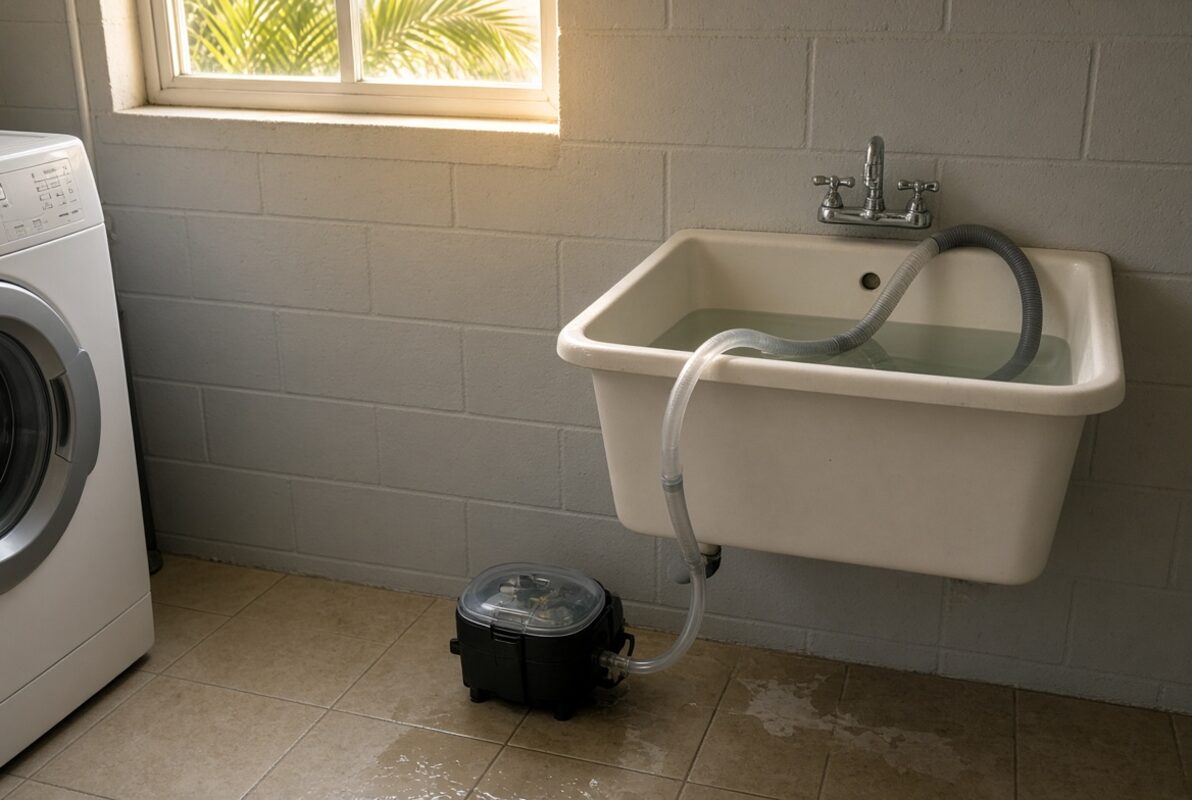
The closet was dry. The air-handler door opened onto a pan with an old stain and no water. The phone never buzzed. The laundry tile told the truth. A clear hose from the condensate pump and the gray washer drain hose both sat in the utility sink. The basin was up to the overflow. A sheet had already left the toe-kick.
That is an October 1 Florida laundry. The coil is still wringing after an overnight shower. The washer still spins a beach load. One sink took both. Reed’s laundry note is the vapor half: the laundry room held the wet load. This note is the basin that could not take two dumps at once.
Why the sink filled
A condensate pump only moves what the coil pulls. On a wet October afternoon that can be a steady trickle into a hose. The hose in this house did not run to its own termination with an air gap. It draped the rim and stopped in the basin. The washer drain hose did the same. A spin cycle dumps faster than a utility sink drains when a second hose is already in the water.
The closet was the wrong room. A pan that stays dry is not the leak. We already walked the closet that actually drips: the closet was dripping. We already walked a pump that never left its own reservoir: the garage pump sat in its own water. This pump left the reservoir. It just shared a sink with the washer.
The standpipe that spits on the slab is a cousin, not this basin: the laundry standpipe spit on the slab. The supply hose that softens on the floor is a different part: the washer hose softened on the slab. Name the hose before you blame the closet.
If the cabinet toe-kick is already stained, pin it. Sight is not a meter: moisture meter after a leak. Laundry-room context for the air after the floor is honest: damp Florida laundry room.
After-work check (five minutes)
You need a look after the spin. Not a rebuild.
- After work, before you start a load, open the laundry door the way it sits at night. Name the sink. Name the tile at the toe-kick.
- Count hoses in the basin. A pump discharge and a washer drain in the same water is the setup.
- Dry your hand. Feel the pump reservoir lid. If the lid is dry and the basin is high, the pump did its job and the sink did not.
- Watch the overflow hole and the floor. A wet oval at the toe-kick means the basin already gave up.
Do not start the washer while you are still looking. Let the basin drop. If it does not drop in a few minutes, the tailpiece is the holdup. Stop. Licensed plumber on site.
A puck on the downhill grout earns its keep here the same way it earns it in a pan. Placement, not a gadget tour: five places a leak puck earns rent.
PumpSpy CP-120 is the assembled-USA condensate pump we list when the old unit can lift, and the hose still dies in a shared sink because nobody gave it a run of its own. FloridaDamp is an Amazon associate — we earn from qualifying purchases. I still point at this one because it is an assembled-USA condensate pump that will actually drain once the hose has a termination, not because anyone paid for a review.
Do not
- Do not blame the closet because the laundry smells wet. Open the pan. A dry pan is not this leak.
- Do not shove both hoses deeper into the basin and call that an air gap. You hid the only look you had at the water line.
- Do not cap the pump hose because the sink overflowed. A capped discharge fills the reservoir, then the floor. The garage version of that failure is already written: the garage pump sat in its own water.
- Do not crack the laundry window onto a wet Wednesday to air the tile. You import the band you just waited out. Reed owns that air: relative humidity after overnight rain.
- Do not park a bucket under the toe-kick and leave for the weekend. A bucket is how you find a ring on the grout in October.
If the supply nut at the washer is wet, the fill never stops, or the baseboard is soft past the stain, stop. Licensed plumber on site. Do not open a pressurized line because the basin looks guilty.
After the tile stays dry
Once the basin drops and the pump hose is out of the shared water, the air is Reed’s job. Log indoor relative humidity (RH) at shelf height, not on the pump lid: hygrometer guide. If the laundry still sits above 60% after an honest floor, that is capacity, not the sink. Hand it to Reed’s pint chart.
Today’s library note is a different shut room, not this basin: the library held the closed books. House-wide context: Florida humidity home guide. Dry tile does not dry a shut laundry.
Run this
- After the next spin, stand at the utility sink. If both hoses are in the basin and the water is at the overflow, shut the washer off and let the sink drop. Towel the toe-kick. Confirm the pump lid is dry so you are not chasing a reservoir that never left.
- Pull the pump hose out of the shared water. It needs its own termination with an air gap, downhill if you have the fall, not a roommate in the washer drain. If you cannot see a standpipe that is not already the washer’s, stop and get a licensed plumber on site. Do not leave it in the mulch. The elbow that sat outside is a different failure: the condensate elbow sat in the mulch.
- When the tile stays honest, pin any stained toe-kick and log relative humidity (RH) for a week. Reed’s laundry note is the vapor half after the same wet load: the laundry room held the wet load. A dry sink does not dry a shut laundry.
The first of the month is not a dry floor. Name the hose. Give the pump its own run. Leave the closet alone if the pan is empty.
If it’s useful, it’s beautiful.