 Reed Lang, Field editor
As an Amazon Associate I earn from qualifying purchases. Some links are affiliate links.
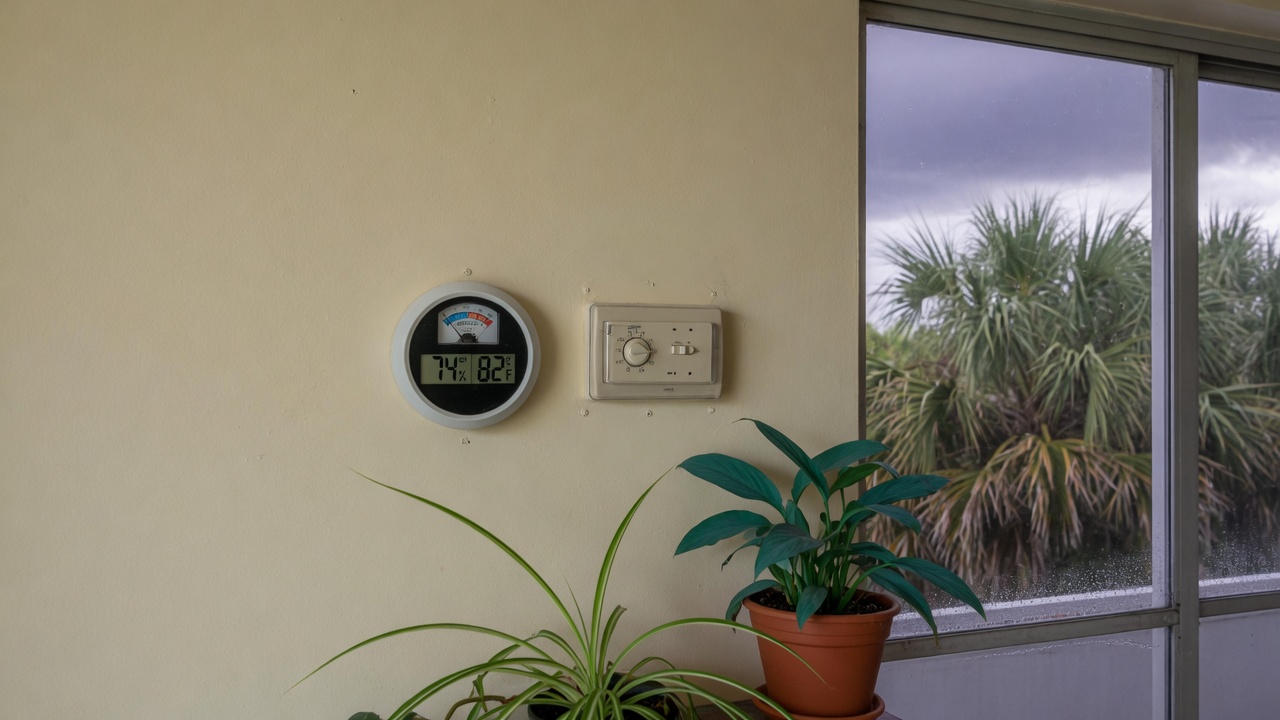
The thermostat can win and the house still lose. That is the Florida trick: 74°F, sofa still damp, hygrometer sitting above 60% relative humidity (RH).
People buy a bigger AC so the rooms “catch up” after a hot afternoon. Bigger dumps cold air faster. The setpoint trips. The compressor stops. Water condenses on a coil only while that coil stays cold long enough for droplets to form and leave through the drain. Five to eight minutes is not that window. You get refrigerated swamp air. We already covered the 68°F version: why 68 still felt clammy.
This note is the sizing version. A short slide deck and a timed slideshow sit with it. Same three lines as the rest of this site: measure first. Size for Florida relative humidity (RH). Drain continuously.
Download the slide deck (PowerPoint)
Two jobs, one runtime
An air conditioner does temperature (sensible) and moisture (latent) on the same coil. In a humid climate the latent slice is not a rounding error. It is often a quarter to a third of the load. Rules of thumb from drier states skip it. They sell extra tons. Extra tons shorten the cycle. Short cycles starve the latent job.
You do not need a lab. You need a hygrometer on an interior wall, away from the supply and away from the slider, and a clock on one ordinary afternoon cycle.
- If relative humidity (RH) holds 45–55% at a normal setpoint, the machine is wringing while it cools. Leave it.
- If relative humidity (RH) sits above 60% while the unit short-cycles, the next conversation is size and runtime, not two more degrees of cooling.
Guide: AC vs dehumidifier in Florida. Targets: Florida humidity home guide. How to walk the house: measure sq ft and AC size.
What “right-size” actually means
Ask the contractor for Manual J, then Manual S. Manual J is the room-by-room load, including infiltration and latent load. Manual S picks equipment that matches that load. Total tons on a banner is not latent capacity. Variable-speed and two-stage machines help because they can stay in the condensing window instead of slamming the thermostat.
I am not a licensed contractor. I am not NATE. I am not going to size your changeout from a chat window. Read the data plate, log relative humidity (RH) for a week, and take those numbers to the person who will stamp the calc.
Fan AUTO. Fan ON after a cycle blows wet-coil air back into the rooms. That is how a house stays clammy at a “reasonable” setpoint.
When the AC still loses
Shoulder season. Overnight rain with a mild day. A house sitting empty. The compressor barely runs. No runtime, no wringing. That is when a dedicated dehumidifier, drained continuously, is the backstop — not another two tons. Size that machine from the pint chart, not from a square-foot sticker.
If a closet pan is wet, that is not a humidity strategy. That is Carlo’s drain: the overflow pan should text you. Fix the line. Then measure the air.
What not to do
- Do not size the next AC from a square-foot banner.
- Do not drop the thermostat to 68°F and call it dehumidification.
- Do not run the fan ON all day.
- Do not skip the hygrometer and argue from “feels sticky.”
Run this
- Log indoor relative humidity (RH) morning and late afternoon for seven days at 74–76°F.
- Time one cooling cycle on a typical afternoon. Under ten minutes plus a hygrometer over 60% is the oversized tell.
- Keep AUTO. Ask for Manual J on the next changeout. If living space still holds water after a correctly running AC, size a continuous-drain dehumidifier for the zone.
Reed Lang writes these notes from coastal Florida. If you have standing water, stained drywall, or growth, call local restoration. A bigger AC will not dry a wet wall.