 Carlo DeLuca, Master plumber
As an Amazon Associate I earn from qualifying purchases. Some links are affiliate links.
A Florida air handler is a water factory with a fan. The coil wrings the Gulf out of the air. That water is supposed to leave through a trap and a slope of white PVC. When the trap clogs — and it will, because algae loves a dark wet pipe — the overflow pan is the only remaining drain.
If you have a float switch, a rising pan kills the compressor. The house gets hot. You come home. You curse the AC. You still have a ceiling.
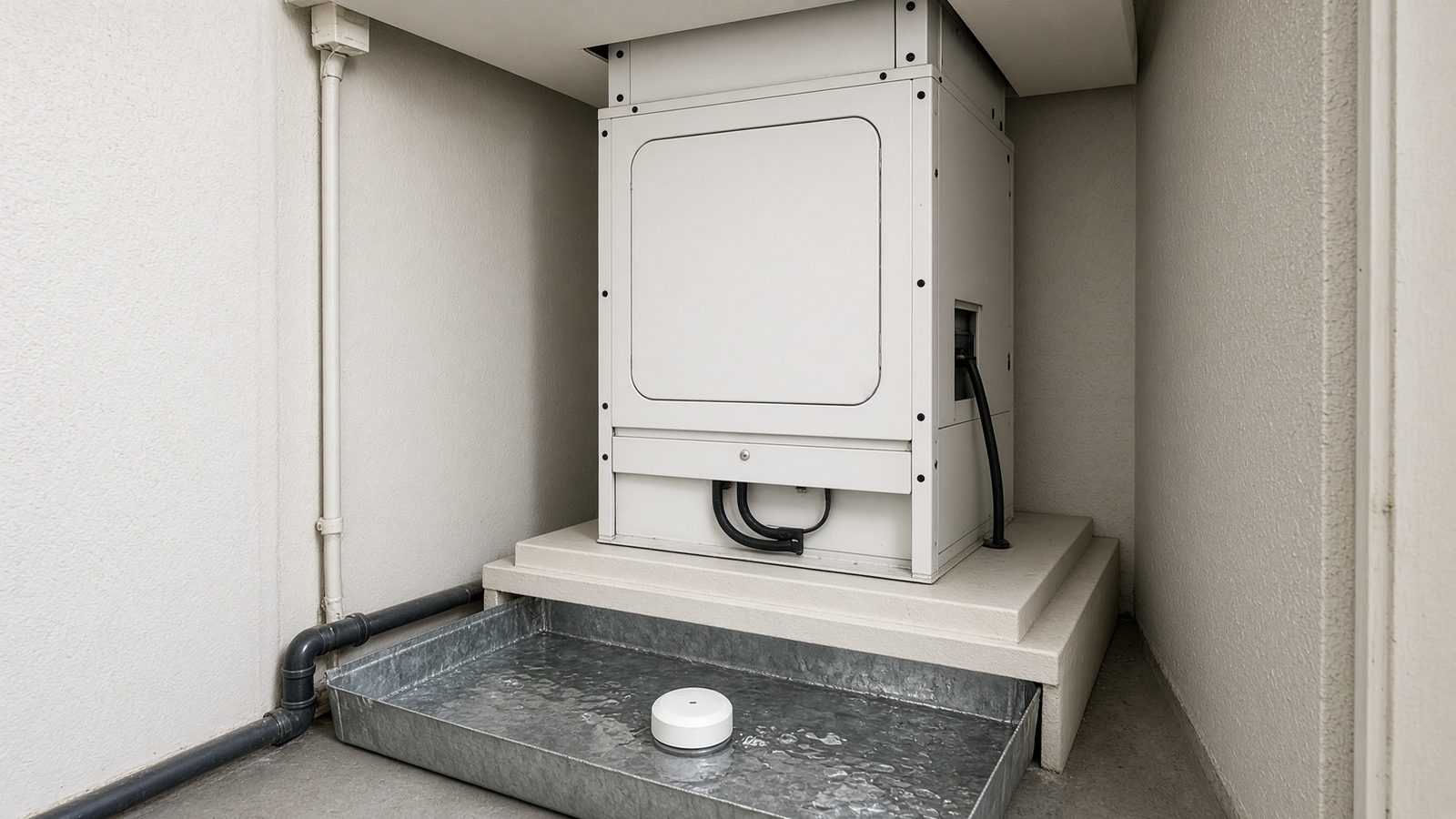
If you have a leak puck in that same pan, your phone buzzes while you are in the car. The house may still be cool. The pan is honest. You get a chance to shut it down on purpose instead of learning from the stain.
Two devices, two jobs
Float switch. Wired into the air handler. Wet = no cooling. It protects the machine and, if you are lucky, the pan. It does not send SMS. It does not care that you are in Jacksonville. The symptom is a hot house.
Leak puck. Battery, pads in the water, gateway on 2.4 GHz Wi-Fi. Wet = siren plus a push to the phone. It does not stop the compressor. It tells a human.
I want both. A kill switch without a witness is how people run the system “one more day” because the house is hot. A witness without a kill switch is how a pan overflows while you sleep. Do not jump the float so the AC will come back on. You will finish the ceiling. I already wrote that: the closet was dripping.
Where the puck sits
In the pan. Not on the return grille. Not taped to the cabinet “so the dog doesn’t knock it.” The water has to touch the pads.
If the pan is metal and rusty, the puck still works. The pan may not. Rusted through is a plumber, not a sensor problem.
If the air handler is in an attic, the gateway needs to hear the puck through insulation and a hatch. Long-range kits exist. A Wi-Fi dead zone is a dead witness. Test it from the driveway with a wet finger before you trust vacation.
The drain is still the job
A text is not a flush. If the pan is wet:
- Kill power at the thermostat or breaker.
- Look at the trap and the cleanout. Flush what you can see. Vinegar in a reachable trap. No crystal bombs down a line you cannot see the end of.
- Confirm water leaves at the splash block or standpipe.
- Empty the pan. Dry the puck. Restore power. Watch one cooling cycle.
If you cannot see the trap, the line is in a wall, or the pan is gone, stop. Licensed plumber or HVAC tech. This note is not a dispatch.
After the pan stays dry through a hot afternoon, Reed can talk relative humidity (RH): hygrometer. If the room still lives above 60%, that is capacity, not PVC. Hand that to the pint chart.
What not to do
- Do not treat a leak alert as permission to keep cooling “so the house doesn’t get stuffy.” You are making more condensate into a failed drain.
- Do not jump the float.
- Do not put the puck in the primary drain itself. It belongs in the overflow, the place that only gets wet when the primary failed.
- Do not assume the siren is enough if the air handler is in a closet with the door shut and you are in Daytona.
Run this
- Open the closet. If there is standing water in the pan, you already have the diagnosis.
- Fix or call out the drain. Then drop a leak puck in the dry pan and confirm the phone buzzes.
- Leave the float switch alone unless a licensed tech is replacing it.
The future is a text from the pan. The plumbing is still slope, a trap, and not hoping.
Carlo DeLuca is a third-generation master plumber. Family trade from Long Island, writing from coastal Florida. This note is not a service call.
If it’s useful, it’s beautiful.