As an Amazon Associate I earn from qualifying purchases. Some links are affiliate links.
Air conditioning cools air and removes some moisture as a side effect. A dehumidifier removes moisture as its primary job, with modest heat output. In Florida, you often need both: AC for temperature, dehumidifier for humidity when cooling demand is low. Based on specs and common Florida use cases—not firsthand testing theater—here is a clear split.
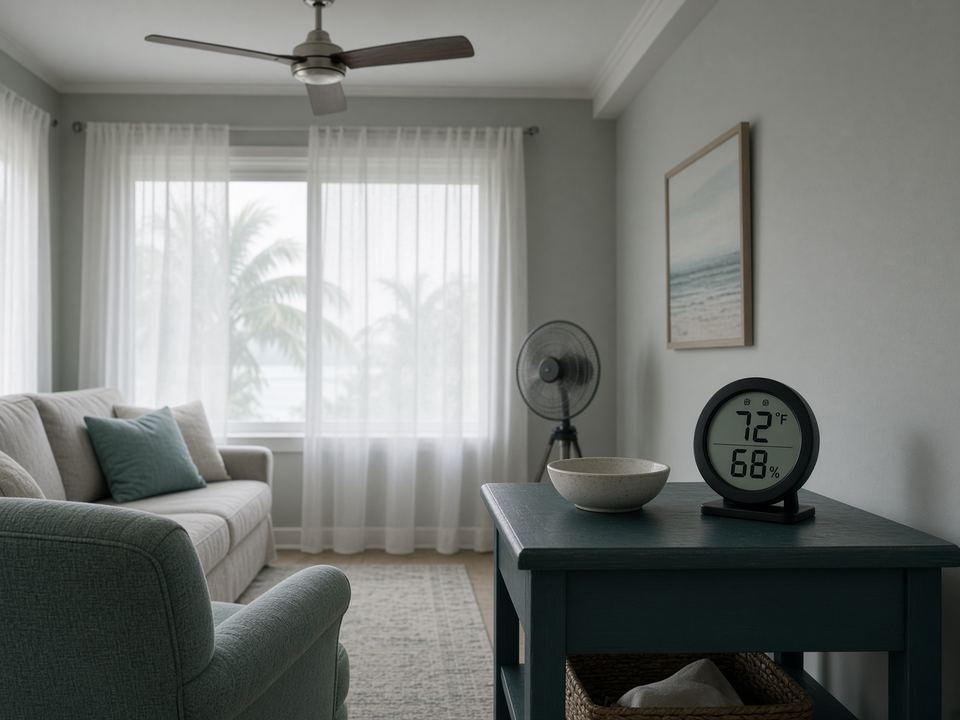
Comfort target for many Florida homes: 45–55% relative humidity (RH), keep sustained levels under 60%. Verify with a hygrometer. Broader context: Florida humidity home guide.
What each appliance does
| Job | AC | Dehumidifier |
|---|---|---|
| Lower temperature | Primary | Not its job (may warm the room slightly) |
| Remove moisture | While cooling / when coils are wet enough | On demand via humidistat |
| Mild rainy days | May short-cycle → weak dehumidification | Continues until relative humidity (RH) setpoint |
| Energy pattern | Driven by thermostat | Driven by humidity setpoint |
Signs AC alone is not enough
- Indoor relative humidity (RH) stays above ~55–60% even when the house feels cool.
- Musty closets, sticky nights, or condensation on windows/sliders.
- Cool setpoints that still feel muggy.
- Shoulder seasons when the compressor barely runs.
Before buying equipment, confirm basics: clean filter, fan AUTO not ON, clear condensate drain, and reasonable thermostat setpoints. Oversized AC that short-cycles is a common Florida humidity culprit—walk square footage vs tons on the data plate first (measure sq ft and AC size). An HVAC pro may need to evaluate that.
When to add a dehumidifier
- You have confirmed high relative humidity (RH) with a separate hygrometer.
- AC maintenance is current and the air still feels damp.
- You need zone control (bedroom, condo Florida room, garage)—see condo and garage.
- You are away for weeks — see keep a closed house dry.
Want USA-built? If the AC cannot hold relative humidity (RH), the living-space path is
AprilAire E080 or
E100C. Crawl/garage is
Santa Fe Compact70, not a whole-home substitute. Consumer portables below are typically overseas-made.
Product picks (humidity backstop)
Educational slots based on specs and common Florida use cases.
Good — Entry continuous-drain portable
Pairs with existing AC for most mid-size zones.
Better — AprilAire E080 Pro (USA-built whole-home class)
For larger open plans or awkward drain paths.
Best monitoring — Hygrometer (do this first)
Buy measurement before guessing capacity. Full guide: hygrometer.
Add-on — Smart plug with energy monitoring (runtime insight)
Helps you see whether the dehumidifier runs constantly (undersized or infiltration issue).
Add-on — AC filter multi-pack (maintenance first)
Keep filtration within your system’s design limits; higher MERV is not always better for every air handler.
Practical operating tips
- Set dehumidifier humidistat near 50% and fine-tune after a week of hygrometer data.
- Keep interior doors configured for the zone you want to treat.
- Use continuous drain—Florida rainy season fills tanks fast (size chart).
- Do not expect a portable to replace crawl encapsulation equipment (portable vs crawl).
- After storms or leaks, meter materials—drywall moisture meter.
Related pages
Thermostat myths
Lowering the thermostat to “dry the air” wastes energy if the coil already short-cycles. You want longer, efficient cooling cycles when heat load exists—and a dehumidifier when heat load disappears but moisture remains. Humidistat-equipped systems and variable-speed equipment can help; portables remain the renter-friendly backstop.
Room-by-room exceptions
- Bedrooms: quieter 30–50 pint class may beat a loud 70-pint unit.
- Open great rooms: bias toward 50–70 pint continuous drain.
- Garages: high-temp capable units (garage).
- Crawls: not an AC job—use crawl equipment (portable vs crawl).
Cost framing without fake ratings
Compare purchase price plus expected runtime. An Energy Star continuous-drain 50-pint unit that cycles at 50% relative humidity (RH) often costs less to live with than a cheap bucket model you abandon. Measure relative humidity (RH) first so you do not buy capacity you cannot verify.
Bottom line
In Florida, AC is the foundation; a dehumidifier is the humidity backstop. Measure relative humidity (RH), maintain the AC, then add a continuous-drain portable sized from the pint chart when cooling alone cannot hold 45–55%.