
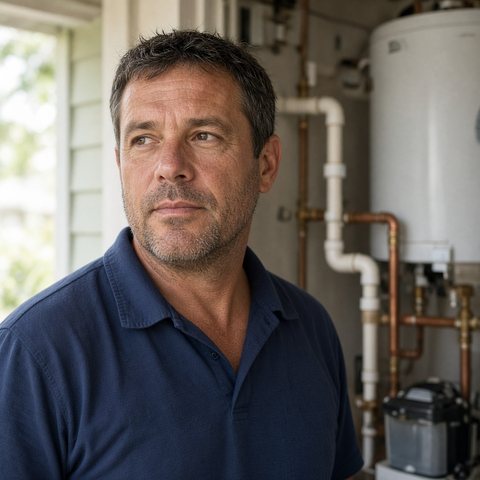
 Carlo DeLuca, Master plumber
As an Amazon Associate I earn from qualifying purchases. Some links are affiliate links.
The garage felt hot, the way a September afternoon in coastal Florida feels. The tank still made hot water. The metal pan under it held a dark puddle and a stub that went nowhere.
That is not a humidity problem first. Reed’s hatch note this morning is vapor in a hallway: the attic hatch breathed wet air. This note is water sitting under a tank because nobody gave it a path out of the house.
I already put a puck in that pan on the placement list: five places a leak puck earns rent. A text is a witness. It is not a drain. Today is the missing pipe.
Why the pan is a bucket
A Florida water heater lives in a garage that hits the nineties. The tank sweats. A fitting weeps. A relief line drips after a long shower. Code wants a pan under that tank when the heater can ruin a floor — and a lot of coastal slabs still count. The pan is supposed to dump to daylight, a floor drain, or a pipe you can see leave the bay.
What I find instead: a metal dish with rust flakes, a factory knockout still plugged, or a two-inch stub capped with a cheap plug. The water has a rim. It does not have an exit. That is a bucket with a tank in it.
A garage slab will hide a slow weep for weeks. Then the shared wall softens. Then the hallway smells closed and someone buys another portable machine.
If the drywall at the shared wall already looks stained, pin it. Looking dry is not a reading: moisture meter after a leak.
After-work check (five minutes)
You do not need to drain the tank on night one. You need a look.
- Flashlight the pan. Standing water, rust tide, or mineral crust is the diagnosis.
- Find the drain opening. Follow it. If it dies at a cap, a plugged knockout, or a hose that ends on the slab, the pan has no job.
- Look at the relief discharge. That pipe should dump where a person can see it — not into a closed pan with no outlet.
- Look at the slab and the first six inches of the shared wall. Dark concrete or a soft baseboard means the bucket already overflowed.
If the pan is dry, the stub is open, and you can see where water would leave the garage, close the door. Do not invent a project.
If the pan is wet and you cannot name a path out, stop shopping for a bigger tank. The pan is the job.
What that missing drain usually is
A lot of coastal Florida heater swaps keep the old pan and skip the pipe. The installer sets the tank, slaps the pan down, and leaves. The knockout stays in. Or someone ran a hose to “the corner” and the hose slipped.
I will not walk you through cutting a live supply. I will not tell you to drill a hole in a rusty pan while the tank is full. Look. Photograph. If you can name the heater shutoff and the pan is overflowing onto the slab, shut the valve if that is the leak. Then a licensed plumber for a real drain to daylight or to a receptor the house already has.
The future is still a text. A puck in the pan, pads in the water, gateway on 2.4 GHz. Test with a wet finger. Confirm the phone buzzes from the driveway. Same rule as the closet and the washer: your phone knows before the ceiling. A dry puck on a high shelf will not hear a pan that has no drain.
What not to do
- Do not treat a wet heater pan as “just garage humidity.” Vapor is Reed’s meter. Standing water under a tank is a pipe problem.
- Do not open a pressurized line because the fitting looks like a hose bib.
- Do not drill the pan “real quick” with the tank live and the slab already dark. Licensed plumber.
- Do not run the heater “one more week” while the pan is a puddle. Shut what you can name. Call what you cannot.
- Do not buy another portable dehumidifier for a flooded heater bay. Give the water a path. Then measure the air.
If the water is in a wall, the valve will not turn, or you hear a spray you cannot see, stop. Licensed plumber on site. This note is not a dispatch.
After the pan is honest
Once the pan stays dry through a hot afternoon and the drain actually leaves the bay, the air is Reed’s job. Log indoor relative humidity (RH) on an interior living-room wall, not on the garage door: hygrometer guide. If the house still sits above 60%, that is capacity, not a tank. Hand it to Reed’s pint chart.
A garage that still rusts tools after a dry pan is its own climate: Florida garage dehumidifier. If last night’s rain also loaded the attic hatch, treat that as a separate job: the attic hatch breathed wet air.
Run this
- After work tonight, flashlight the heater pan and the first six inches of slab. Standing water or a capped stub is the diagnosis.
- Find the shutoff. If you can name it and the tank is the leak, close it. If you cannot name it, do not hunt with a wrench. Call a licensed plumber for a drain that actually leaves the bay.
- When the pan is dry, drop a leak puck where water would pool and confirm the phone buzzes. Then log relative humidity (RH) for a week. Reed’s hatch note from this morning is the vapor half of a wet September house: the attic hatch breathed wet air. A dry heater pan does not dry a leaky attic door.
Carlo DeLuca is a third-generation master plumber. Family trade from Long Island, writing from coastal Florida. This note is not a service call. If the pan is rusted through or the tank is live and you cannot find the shutoff, get a licensed plumber on site.
If it’s useful, it’s beautiful.