 Carlo DeLuca, Master plumber
As an Amazon Associate I earn from qualifying purchases. Some links are affiliate links.
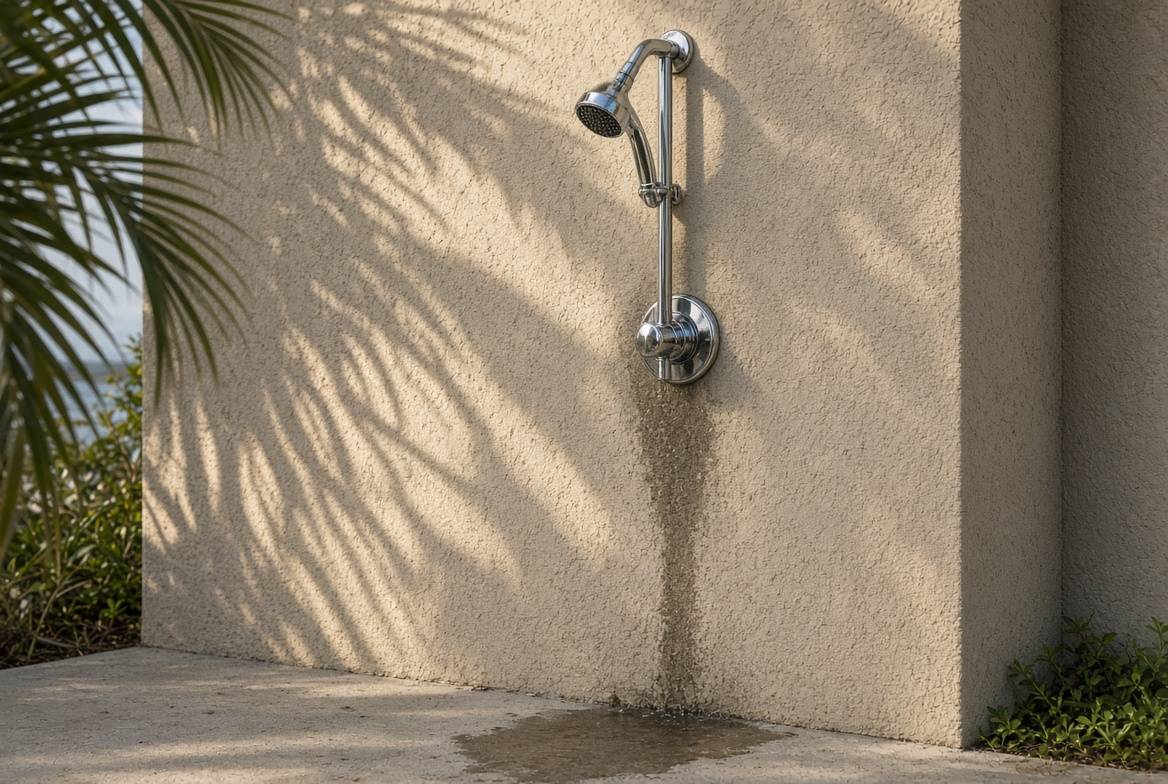
After work the pad under the outdoor shower was still dark. The chrome valve sat on beige stucco. A wet streak left the round escutcheon and ran to a puddle at the wall. Palm shade cut the wall into stripes. The eave above the head was dry. That is a coastal Florida house on October 9, not a roof that decided to talk.
The Florida-room bib is a different fitting, and it weeps on tile: the Florida room hose bib wept on the tile. A condo stack that marks the baseboard is a different path: the condo stack wept at the baseboard. I am naming the outdoor shower valve. The roof edge was dry. The streak started at the metal on the wall.
Why the valve is the job
An outdoor shower is a supply stop in the wall and a riser on the stucco. The handle, the escutcheon, and the joint where the riser leaves the plate are the places a rinse leaves water. Gravity does the rest. The streak on the stucco is the path you can see. The cavity behind the stucco is the path you cannot.
A roof drip hits higher. It starts at the eave, the flashing, or a nail line, and it does not care that a shower head hangs below it. A valve drip starts at the plate and runs down from there. Wipe the escutcheon. Wipe the eave. Wait. Name the one that comes back.
The bib on the Florida room is a hose thread on a finished wall, usually over tile. This one is a shower valve with a riser, usually on the pool side or the side yard, over a pad. Same family of supply. Different fitting. Do not merge them because both can wet a wall.
October does not retire the rinse. Salt air still sits on the stem. A tired packing nut still gives the escutcheon a place to drip after the handle is off.
After-work check
Before you blame the roof. Before you smear caulk around the plate and leave for the night.
- Walk the pad. Find the valve and the riser, not the eave, and not the hose bib on the other wall.
- Dry the escutcheon and the first hand of the streak with a rag. Dry the eave metal if you can reach it without a ladder stunt. Wait a minute with the light still good.
- A bead that returns at the handle, the escutcheon, or the riser joint is this note. A bead that returns at the eave is the roof. Do not merge them because both can darken stucco.
- Step inside on the same wall. A dull baseboard or a soft toe-kick is the path that already crossed. Log it. The fitting that drips again after you wipe it is a pattern.
- Feel the puddle with the back of a finger, briefly. A valve drip after a rinse is usually cool. Do not hold a hand under a head that is still running.
If the valve is dry and the eave is the only wet metal, close this note.
Do not
- Do not caulk the escutcheon and call the wall sealed. Caulk hides the path. It does not name the fitting. A packed stem still weeps behind a pretty ring.
- Do not cut the riser or open the valve on a live line. This note names the drip. A licensed plumber owns the valve and the stop in the wall.
- Do not blame the roof because the stucco is dark under the head. Dry the eave first. A dry eave and a wet plate is not a shingle story.
- Do not hang a bucket on the riser and call the shower done. The film still walks if the pad pitches toward the house.
- Do not size a machine for the cabana because the pad is wet. Room air after the fitting is named belongs to Reed. The cabana bath stayed shut. I am naming a valve.
Run this
- After work, confirm the drip starts at the escutcheon or the riser joint and the eave is dry, so you are not re-running a roof leak.
- A slow bead: wipe, wait, write down whether it returns, and which piece of metal it returns on. If the plate is running, not beading, shut the local shower stop if you already know that handle, and stop. Do not open the wall. Get a licensed plumber.
- If the film walked inside toward the hall or the cabana door, bag the threshold before the night. Pin any dull drywall the valve faced. When the fitting is seated, hand relative humidity (RH) in that room to Reed. A quiet valve does not dry a wall that already took the rinse.
A USA flood bag at the interior threshold buys time if the streak walked through the wall. It does not reseat a valve. It keeps the film off the hall.
If the interior wall already took the streak, pin it. A USA-made pin meter tells you whether the dull stripe is surface or already in the paper. Looks-dry is not dry. Reed’s meter note is the handoff after the wall is honest: drywall can look dry and still be wet. The meter guide is the same job: best moisture meter for drywall after a leak.
FloridaDamp is an Amazon associate — we earn from qualifying purchases. I still point at these two because a USA flood bag holds a shower weep off the hall and a USA-made pin meter reads the drywall the valve faced, not because anyone paid for a review.
Relative humidity (RH) on that cabana wall is Reed’s beat after the valve is named. House-wide context sits in the Florida humidity home guide. Salt air and a wet shell are the coastal page: coastal Florida dehumidifier. If the film already left the pad and entered the house, the dry-out page is next: post-storm dry-out.
October still finds an outdoor shower that nobody wiped after the rinse. The eave can be dry and the stucco can still take a streak. Name the valve. Leave the cutter in the truck.
If it’s useful, it’s beautiful.